How to Get Urine Smell Out of Carpet (and Stop It Coming Back)

You’ve cleaned up the accident. The carpet looks fine, and for a while, you think the problem has gone. Then a few days later, you walk into the room, and there it is again. That unmistakable smell of wee.

It can be particularly noticeable on warm days or after the carpet has dried.

Whether the accident came from a dog, cat, another pet, a young child or an older family member, the problem is often the same. Urine can soak deeper into the carpet than ordinary surface cleaning can reach.

The good news is that a fresh accident can often be treated at home if you act quickly. Older patches are more difficult, particularly when urine has reached the carpet backing or underlay.

Here’s how to get urine smell out of carpet, which cleaning products to avoid, and when professional help may be the more sensible option.

If your problem is an everyday doggy odour rather than a urine accident, our guide to general dog smell in carpet may be more helpful.

Carpet Urine Odour Removal Guide

Why urine smell lingers in carpet

The frustrating thing about urine is that removing the visible stain doesn't necessarily remove the cause of the smell.

Carpet has several layers. Beneath the fibres you walk on is the backing, followed by the underlay and subfloor. Liquid can travel through these layers, especially if a puddle has been left for some time.

As urine ages, bacteria break down its compounds, producing the sharp, ammonia-like smell associated with old urine.

Dried urine can also leave residues, including uric acid salts and crystals, that are difficult to remove with ordinary household cleaning.

There is another reason the problem sometimes returns: wicking.

When a carpet is cleaned, moisture can move through the fibres and backing as it dries. Residue from deeper down may be carried towards the surface, bringing back a faint mark or unpleasant odour.

This helps explain why a carpet can smell worse after cleaning, even when it initially seemed fresher.

A scented carpet deodoriser may make the room more pleasant temporarily, but masking odours is different from removing the contamination causing them.

1B-CB4-1BP-Carpet-Cleaning-After-Service-Art-of-Clean-Cambridge
1697367050_24-Twenty-Pence-Road-wilburton-carpet-cleaning-service-art-of-clean-cambridge-GMB

How to clean a fresh urine accident

If you've just discovered a puddle, act quickly without soaking or scrubbing the carpet.

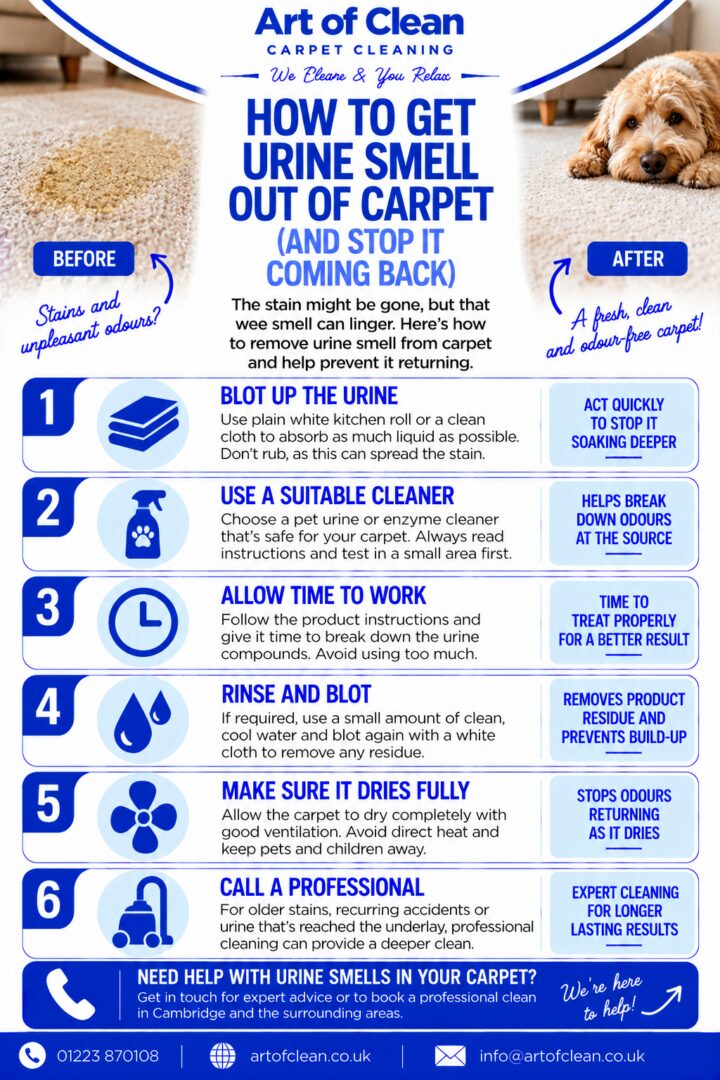
  1. Blot up as much urine as possible

Use plain white kitchen roll or a clean white cloth.

Press firmly onto the wet area to absorb the liquid. Replace the paper or move to a clean section of cloth as it becomes damp.

Avoid rubbing. This can spread the urine across the fibres and make the affected area larger.

Work from the outside of the patch towards the centre.

  1. Choose an appropriate urine cleaner

For many suitable synthetic carpets, a pet urine cleaner or enzyme cleaner may help break down the compounds responsible for lingering odours.

Choose a product specifically labelled for the carpet material, read its instructions and carry out a patch test in an inconspicuous area first.

Not every enzyme cleaner is suitable for every carpet, particularly wool, silk or delicate materials.

  1. Allow the product time to work

Follow the manufacturer's instructions for application and contact time.

Some urine-specific products need time to act before the remaining liquid is blotted away. Applying more than the recommended quantity won't necessarily improve the result.

Avoid soaking the carpet.

  1. Rinse and blot where instructed

If the product instructions require rinsing, use a small amount of clean, cool water and blot again with a white cloth.

The aim is to remove residue without pushing additional moisture into the backing.

  1. Allow the carpet to dry completely

Good ventilation helps. Open a window or use a fan to encourage airflow, avoiding direct heat on the affected patch.

Keep children and pets away while treatment is taking place and until the carpet is fully dry.

Once dry, check whether the smell has improved before applying anything else.

How to get old or dried urine smell out of carpet

Old urine is more difficult because the original liquid may have spread beyond the stain you can see.

Sometimes the carpet looks completely clean, but the smell tells a different story.

Start by finding the affected area. Check places where pets regularly rest or spend time, including corners, near skirting boards and around furniture.

A UV light or torch may help identify some dried urine deposits in a dark room. However, UV marks aren't conclusive proof of urine, and not every contaminated area will glow.

Once you've located the likely area, check the carpet's care instructions before using a suitable enzyme or urine-specific cleaner.

Treat the affected area according to the product instructions, remembering that contamination may extend beyond the visible mark.

Avoid flooding the carpet in an attempt to reach deeper urine. Without suitable extraction, you may simply move the contamination further down.

A wet and dry vacuum designed for liquid extraction can sometimes help remove moisture during suitable cleaning procedures, but it isn't a guarantee that dried urine in the underlay has been removed.

If the carpet has been affected repeatedly, home treatment may reduce the smell without eliminating it completely. That is usually the point to stop experimenting and investigate what is happening underneath.


Carpet Cleaning After 1

What not to use on urine in carpet

It's tempting to reach for whatever cleaning product is already in the cupboard. Unfortunately, some products can damage the carpet or make the problem harder to resolve.

Ammonia-based cleaners: These are particularly unsuitable for pet urine. Their smell can resemble urine to animals, potentially encouraging them to revisit the same area.

Bleach: Bleach can cause permanent colour loss and damage certain fibres. Our guide to Can You Bleach a Carpet Without Ruining It explains the risks.

Hydrogen peroxide: Although it appears in some online stain-removal recipes, hydrogen peroxide can lighten carpet dyes. Don't experiment with it on an unknown carpet.

Steam cleaning and excessive heat: High heat can make some urine staining more difficult to remove. Avoid using a domestic steam cleaner on an untreated urine patch.

Washing-up liquid: Ordinary household detergents may leave sticky residues that attract dirt. They are especially unsuitable as an improvised treatment for delicate wool carpets.

Most importantly, never mix cleaning products.

Mixing bleach and ammonia-based sprays or some types of toilet cleaners can release extremely dangerous fumes. Bedfordshire Fire and Rescue Service advises keeping chemicals in their original containers, following label instructions and ventilating the area.

If you've already applied one product, don't immediately add another. Check the instructions and seek advice if you're unsure how to proceed safely.


Do vinegar and bicarbonate of soda work?

White vinegar and bicarbonate of soda are frequently recommended as inexpensive solutions for carpet odours.

But there is an important difference between making a carpet smell fresher and removing urine contamination.

Bicarbonate of soda may help absorb some unpleasant smells from a dry surface. It cannot reliably remove urine that has soaked into the backing or underlay.

Diluted white vinegar is also commonly suggested for household odours. However, it isn't appropriate for every carpet, particularly delicate fibres such as silk, and it shouldn't be treated as a guaranteed urine remover.

If you choose a vinegar-based method, check the manufacturer's carpet-care guidance and patch test first.

Avoid layering bicarbonate of soda, vinegar, detergent and commercial cleaning products over the same patch.

A carpet that has already received several home treatments can be more difficult to assess, particularly when residues remain in the fibres.

Where urine odour persists, using a suitable urine-specific product is generally a better approach than repeatedly adding household remedies.

What if the urine is on a wool carpet or rug?

Wool deserves particular care.

It's found in many Cambridge homes, including period properties, and can be affected by unsuitable cleaning chemicals, excessive moisture and aggressive rubbing.

For fresh urine on wool, carpet manufacturer Cormar recommends blotting up the liquid, then applying a WoolSafe Approved Pet Stain Remover to a damp white cloth and gently blotting the affected area.

Follow this with careful blotting using clean water, dry the area with a white cloth and gently realign the pile.

For old urine staining on wool, professional advice is particularly sensible. Repeated home treatments can create additional problems without reaching the original contamination.

Rugs bring another consideration. Urine may pass through the rug onto the floor underneath.

Check the flooring beneath a rug and clean it using a method suitable for that surface. If the rug is delicate, valuable or heavily contaminated, avoid soaking it and seek specialist advice.


When the smell has reached the underlay

Sometimes the carpet itself isn't the whole problem.

If urine has soaked into the underlay, cleaning the top fibres may leave much of the source untouched.

Possible warning signs include a smell that seems strongest near the floor, odour that returns after cleaning, or an area that repeatedly feels damp.

The smell may even become more noticeable when the room is warm or humid.

Before assuming the worst, remember that a damp smell can also have other causes. Our guide to moisture trapped in the underlay explains why moisture problems aren't always visible at the surface.

In some cases, properly investigating the contamination involves lifting a section of carpet to examine the backing, underlay and subfloor.

This needs care. Carpet gripper rods have sharp pins, and pulling at a fitted carpet incorrectly may cause damage.

A carpet fitter can help where lifting or replacing materials is necessary.

If urine has repeatedly soaked into one area, replacing a contaminated section of underlay may be more sensible than continuing to clean the surface. Sometimes the subfloor also needs appropriate treatment.

Professional extraction can remove more liquid from accessible carpet layers than ordinary blotting, but it cannot guarantee removal of contamination trapped beneath the carpet.

What about cat urine?

Cat urine can produce a particularly strong, persistent smell, especially when it has dried or affected the same area repeatedly.

The underlying cleaning principle is similar: locate the contamination, use a suitable urine-specific treatment and avoid leaving residues that may attract the cat back.

However, cat accidents may also involve marking behaviour, so removing the smell is only part of addressing the problem.


Stopping repeat accidents in the same spot

For pet owners, the worry often isn't just today's smell. It's whether the animal will return tomorrow.

Pets may still detect urine residue that people can no longer smell. That makes thorough cleaning important, alongside any training or routine changes.

Keep the treated area inaccessible until it is completely dry. If possible, temporarily block access while you check whether the smell has genuinely gone.

Regular carpet care may also make it easier to notice new accidents before they become established.

If a previously house-trained pet suddenly starts having accidents indoors, speak to your vet rather than assuming it is simply a behavioural issue.


When to call a professional carpet cleaner

There comes a point when another bottle of carpet cleaner probably isn't the answer.

Professional advice is worth considering when:

  • The smell returns after repeated home cleaning.
  • Several accidents have happened in the same area.
  • The carpet is wool or another sensitive material.
  • The affected area is large or difficult to locate.
  • You suspect urine has reached the underlay.
  • You're considering replacing a carpet because of the smell.

At Art of Clean, we understand that the main question is often whether the carpet can be cleaned successfully or whether the contamination is too extensive.

A sensible starting point is to explain the problem, including how long it has been there, whether accidents have happened repeatedly and which products you've already tried.

The carpet's material, condition and extent of contamination all matter when deciding what treatment may be appropriate.

Professional treatment may improve staining and odours that ordinary home cleaning cannot adequately address, but some long-standing contamination has honest limits.

There are situations where replacing affected underlay or carpeting may be more practical.

If you're weighing up the options, our comparison of DIY vs Professional Carpet Cleaning Service may help. You can also read about how long carpets take to dry after professional cleaning.

The important thing is to understand what's realistic before spending more money on another treatment.

You can contact Art of Clean about our carpet cleaning service and explain the urine problem when requesting a quote.


Need help with urine smell in your carpet? Ask Art of Clean

The best first steps are straightforward: blot fresh urine quickly, choose a suitable cleaning product, avoid over-wetting and don't use bleach or ammonia-based cleaners.

But if the smell keeps returning, the problem may be deeper than the carpet surface.

Art of Clean helps homeowners across Cambridge and Cambridgeshire with everyday carpet care and more difficult cleaning concerns, including enquiries from Ely, Huntingdon, St Ives, Newmarket, Royston, Saffron Walden and Haverhill.

If you've been struggling with a recurring urine smell, tell us what's happened and what you've already tried. We can discuss the situation and the sensible next step without promising a result before the carpet has been properly assessed.

If the accident affected a sofa or chair instead, you can also enquire about our Upholstery Cleaning Services.

Frequently Asked Questions

Answers to common questions about our How to Get Urine Smell Out of Carpet (and Stop It Coming Back) service.